Study Smarter, Not Harder: Science-Backed Exam Strategies
Discover science-backed study tips for middle schoolers to prepare for exams, improve memory, beat stress, and achieve top grades easily.
Study Smarter, Not Harder: Science-Backed Exam Strategies
Discover science-backed study tips for middle schoolers to prepare for exams, improve memory, beat stress, and achieve top grades easily.
Title
Study Smarter, Not Harder: Science-Backed Exam StrategiesSeo_intro
Discover science-backed study tips for middle schoolers to prepare for exams, improve memory, beat stress, and achieve top grades easily.
Parts
- Part_number: 1Text:
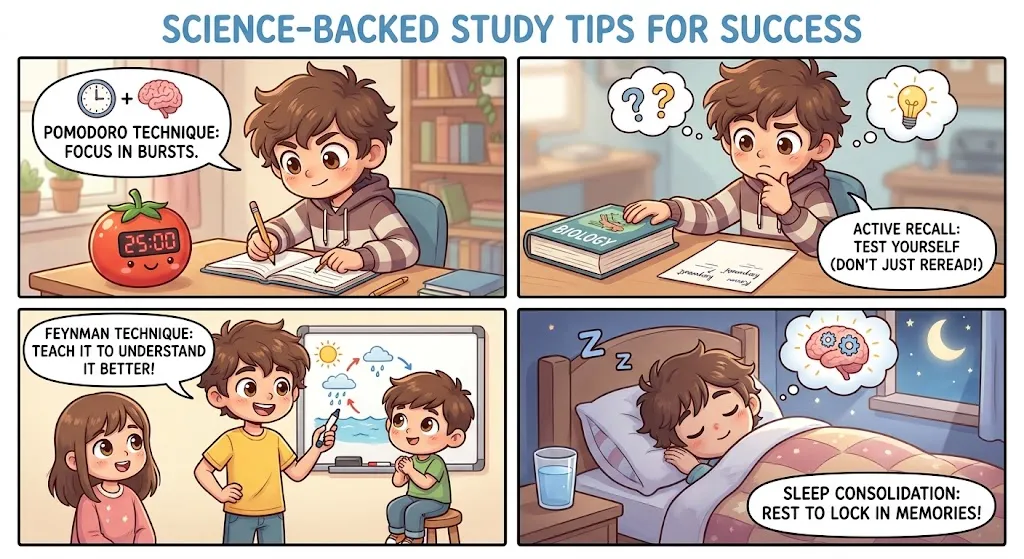
Many students think studying for hours without stopping is the best way to prepare for an exam. However, cognitive research shows that this habit quickly drains your mental energy. Instead, your brain functions much better when you divide work into shorter blocks. A proven method is the Pomodoro Technique, where you focus completely for twenty-five minutes and then take a five-minute break. During this quick pause, step away from your study desk. Stretch, grab water, or look out a window. This planned routine resets your attention span and keeps your mind alert.
Vocabulary_explanations
Cognitive: Related to thinking, understanding, learning, and mental processes.Drains: Uses up completely, leaving little or nothing left.Mental energy: The power and ability of your mind to focus and solve problems.Functions: Works or operates in a particular way.Divide: To separate something into smaller sections or parts.Proven: Tested and shown to be true or effective.Focus: To give all your attention to a single task.Pause: A short period of time when you stop an activity.Routine: A fixed series of actions that you do regularly.Attention span: The length of time a person can concentrate on an activity.Questions:- Question: Studying continuously for hours without pausing is the most effective way to remember facts.Options:
- True
- False
Answer: False - Question: How long should you focus before taking a break in the Pomodoro Technique?Options:
- A) 15 minutes
- B) 25 minutes
- C) 60 minutes
Answer: B) 25 minutes - Question: What is recommended to do during a five-minute study break?Options:
- A) Keep reading your notes quickly
- B) Play video games for an hour
- C) Stretch and drink water
Answer: C) Stretch and drink water
- Part_number: 2Text:
Simply reading your textbook over and over feels easy, but it creates an illusion of competence. Your eyes recognize the sentences, so you wrongly assume that the information is securely locked in your memory. Cognitive scientists encourage an alternative called active recall. Instead of passively reviewing notes, close the book and quiz yourself. Write down main definitions from memory, answer practice questions, or explain complex ideas out loud in your own words. When your brain works hard to retrieve facts, the neural pathways become significantly stronger, making recall effortless during test day.
Vocabulary_explanations
Illusion of competence: Thinking you know or understand something well when you actually do not.Recognize: To identify someone or something because you have seen them before.Assume: To accept something as true without checking for real proof.Securely: Firmly, safely, and in a way that will not be lost.Active recall: A study technique where you test yourself to pull facts out of memory.Passively: Receiving or observing without taking direct action.Retrieve: To find and bring back stored information.Neural pathways: Connected trails of brain cells that send signals and store habits or memories.Significantly: In a very noticeable or meaningful way.Effortless: Needing little or no hard work; very easy.Questions:- Question: Rereading a chapter several times guarantees you will remember it during a test.Options:
- True
- False
Answer: False - Question: What is an example of active recall?Options:
- A) Quizzing yourself without looking at notes
- B) Highlighting every sentence with bright markers
- C) Listening to quiet music while reading
Answer: A) Quizzing yourself without looking at notes - Question: What happens when your brain works to pull facts out of memory?Options:
- A) It forgets other subjects
- B) Neural pathways become stronger
- C) Your attention span gets shorter
Answer: B) Neural pathways become stronger
- Part_number: 3Text:
Cramming all night right before a major test is a recipe for failure. While you might temporarily hold a few definitions, your brain quickly forgets them due to cognitive overload. A much smarter alternative is spaced repetition. This strategy means reviewing study material over several days or weeks with expanding intervals. For instance, review a chapter today, check it again after two days, and revisit it next week. Spacing your review forces your brain to re-learn details just as you start to forget them, which helps transfer facts into long-term memory.
Vocabulary_explanations
Cramming: Trying to learn an enormous amount of information in a very short time.Recipe for failure: A plan or behavior that is almost certain to result in bad outcomes.Temporarily: For only a limited period of time; not permanently.Cognitive overload: A state when your brain receives too much information at once and cannot process it.Spaced repetition: Reviewing material at planned intervals over time to improve memory.Intervals: The periods of time between two different events.Expanding: Becoming larger or greater in size, amount, or time.Revisit: To look at, read, or think about something again.Transfers: Moves something from one place or system to another.Long-term memory: The storage system in the brain that holds information for weeks, months, or years.Questions:- Question: Cramming right before an exam is an effective way to keep facts in long-term memory.Options:
- True
- False
Answer: False - Question: What is spaced repetition?Options:
- A) Repeating words as fast as possible
- B) Reviewing lessons across scheduled intervals over days or weeks
- C) Studying only with friends in large classrooms
Answer: B) Reviewing lessons across scheduled intervals over days or weeks - Question: Why is spaced repetition useful?Options:
- A) It eliminates the need for any sleep
- B) It transfers facts into long-term memory
- C) It lets you skip the actual test
Answer: B) It transfers facts into long-term memory
- Part_number: 4Text:
If you truly want to master a tough concept, pretend you need to teach it to a sixth-grade beginner. This technique is known as the Feynman Technique. When you simplify ideas into plain language, you immediately spot knowledge gaps that you skipped before. Remove complicated jargon and explain why a formula works or why a historical event happened. You can use visual analogies or simple drawings. If you stumble or reach an explanation that sounds confusing, open your notebook and review that specific section again until your explanation flows effortlessly.
Vocabulary_explanations
Master: To gain complete knowledge, skill, or control of a subject.Concept: An abstract idea, principle, or general understanding of something.Feynman Technique: A learning method where you explain concepts simply as if teaching an absolute beginner.Simplify: To make something easier to understand or do.Knowledge gaps: Missing pieces of information or topics you do not fully understand yet.Jargon:Special words or technical expressions used by a particular group that others find hard to understand.
Analogies: Comparisons between two things that show ways they are similar.Stumble: To make mistakes or speak in a hesitant, clumsy way.Flows: Moves along smoothly and easily without interruption.Effortlessly: Done so smoothly that it appears simple and natural.Questions:- Question: The Feynman Technique involves using complex technical jargon to sound professional.Options:
- True
- False
Answer: False - Question: What is the primary benefit of explaining a concept simply?Options:
- A) It exposes gaps in your personal understanding
- B) It makes the exam much shorter
- C) It earns extra credit from your school automatically
Answer: A) It exposes gaps in your personal understanding - Question: What should you do if your explanation stumbles or gets confusing?Options:
- A) Ignore that chapter completely
- B) Return to your notes and review that specific part
- C) Give up on the topic entirely
Answer: B) Return to your notes and review that specific part
- Part_number: 5Text:
Finally, remember that human memory is deeply tied to biological health. Sacrificing your night of sleep to study damages memory consolidation. While you sleep, the brain filters daily events, organizes memories, and cleans out waste products. Without eight to nine hours of rest, concentration suffers and exam anxiety rises. Furthermore, proper hydration and balanced nutrition keep your thinking sharp. Instead of sugary energy drinks that cause sudden tiredness, drink fresh water and eat healthy snacks like nuts, fruit, or yogurt. Treat your body well, and your sharp brain will reward you.
Vocabulary_explanations
Biological: Connected to living bodies, health, and natural life functions.Sacrificing: Giving up something important or valuable to achieve another goal.Consolidation: The process where short-term memories are turned into solid, lasting memories.Filters: Separates important items from unimportant items.Waste products: Unwanted or harmful materials produced by the body that must be cleared away.Anxiety: A feeling of fear, worry, nervousness, or unease about an upcoming event.Hydration: Taking in enough water to keep your body healthy and functioning well.Nutrition: The food and nutrients needed for health, growth, and energy.Tiredness: The state of wishing for sleep or rest; lack of energy.Reward: To give something good or beneficial in return for helpful behavior.Questions:- Question: Your brain organizes memories and cleans out cellular waste while you are asleep.Options:
- True
- False
Answer: True - Question: How many hours of sleep are suggested for middle school students before an exam?Options:
- A) 4 to 5 hours
- B) 6 hours maximum
- C) 8 to 9 hours
Answer: C) 8 to 9 hours - Question: Why should students avoid sugary energy drinks during study periods?Options:
- A) They cause sudden tiredness after sugar rushes
- B) They make books impossible to read
- C) They erase past memories permanently
Answer: A) They cause sudden tiredness after sugar rushes
Critical Thinking
Title: Critical Reflection & ApplicationInstructions:Compare 'active recall' with 'rereading notes.' Why does rereading make you feel confident even if you haven't actually learned the material?
Design a personal 3-day study schedule for an upcoming exam using both the Pomodoro Technique and Spaced Repetition.
References
Recommended for You
Smart Study Secrets: Easy Ways to Ace Your Tests
Discover easy, science-backed study tips for middle schoolers to improve memory, prepare for exams, and study with confi...

Interviews on AI: Thai Graduates at a Career Crossroads
Explore three personal interview perspectives on how AI will shape job opportunities for university graduates in Thailan...

The Origin of 'Carbon Footprint'
Explore how the concept of the carbon footprint was created and why focusing on individual guilt affects working communi...