
Four Proven Habits for Daily Fluency
Discover four science-backed language learning strategies including comprehensible input, shadowing, and a daily 20-minute routine for steady fluency.
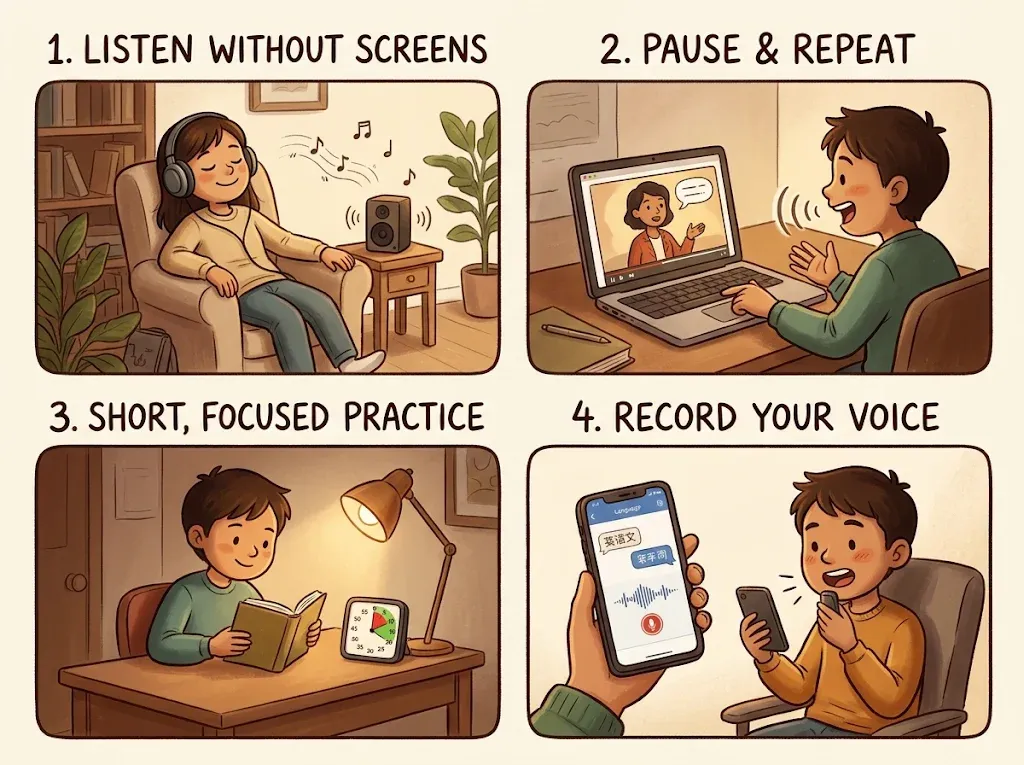
Four Proven Habits for Daily Fluency
Discover four science-backed language learning strategies including comprehensible input, shadowing, and a daily 20-minute routine for steady fluency.
Title
Four Proven Habits for Daily FluencySeo_intro
Discover four science-backed language learning strategies including comprehensible input, shadowing, and a daily 20-minute routine for steady fluency.
Parts
- Part_number: 1Text:
Many students believe that speaking immediately is the fastest route to fluency, but research suggests another path. The theory of comprehensible input argues that our brains acquire speech naturally when we absorb messages we mostly understand. Instead of forcing conversations too early, experts recommend adopting a listen first, speak later mindset. When you prioritize listening, you give your mind sufficient time to recognize recurring speech rhythms, grammatical structures, and everyday expressions without unnecessary stress. By focusing on meaning rather than immediate output, language acquisition happens gradually, mimicking how children effortlessly absorb their mother tongue.
Vocabulary_explanations
Fluency: The ability to speak or write a language smoothly, easily, and correctly.Comprehensible input: Language material that a learner can understand even if they do not know every single word.Acquire: To gain a skill, habit, or knowledge through practice and exposure.Absorb: To take in information or knowledge into the mind naturally.Listen first, speak later: An approach where learners focus on hearing speech before trying to produce sentences.Mindset: A particular attitude or way of thinking about something.Recurring: Happening again and again at regular intervals.Rhythms: The natural musical beats and tempos found in spoken words.Language acquisition: The natural process by which humans learn and master a language.Mother tongue: The first language a person learns to speak in childhood.Questions:- Question: The comprehensible input theory claims that learners must speak before they listen.Options:
- True
- False
Answer: False - Question: Why do experts advise adopting a 'listen first' mindset?Options:
- A) It eliminates the need to ever speak the language.
- B) It allows the brain time to recognize speech patterns without stress.
- C) It helps learners memorize grammar rules from textbooks faster.
Answer: B) It allows the brain time to recognize speech patterns without stress. - Question: According to the passage, language acquisition occurs in a way similar to how:Options:
- A) Children learn their first language.
- B) Adults study for university exams.
- C) Actors memorize movie scripts.
Answer: A) Children learn their first language.
- Part_number: 2Text:
Watching foreign media is popular, but relying on translated subtitles often creates an obstacle. When your eyes read native language subtitles, your visual attention overrides auditory processing. Consequently, your ears stop decoding speech sounds because reading feels easier. To overcome this hurdle, turn off home subtitles entirely. If you feel overwhelmed, switch to target-language subtitles instead, or pick simpler cartoons and podcasts. This adjustment compels your ears to decipher distinct syllables, vocal inflections, and sentence boundaries. Engaging directly with spoken media trains your brain to process genuine dialogue in real time.
Vocabulary_explanations
Obstacle: Something that makes it difficult to achieve a goal or move forward.Subtitles: Words shown at the bottom of a screen translating or transcribing the dialogue.Visual attention: The ability to focus your eyes and sight on specific details.Auditory processing: How the brain recognizes and interprets sounds and spoken words.Overrides: Takes priority over something else or replaces its function.Hurdle: A problem or difficulty that must be solved or jumped over.Compels: Forces or strongly pressures someone to do an action.Decipher: To succeed in understanding something coded, distorted, or difficult.Vocal inflections: The changes in pitch or tone of a person's voice while speaking.Sentence boundaries: The points where one complete thought ends and another begins in speech.Questions:- Question: Native language subtitles help your ears focus better on auditory speech.Options:
- True
- False
Answer: False - Question: What happens when you turn off native subtitles while watching videos?Options:
- A) Your ears are forced to work harder to decipher sounds.
- B) You immediately forget all vocabulary words.
- C) The video playback speed slows down automatically.
Answer: A) Your ears are forced to work harder to decipher sounds. - Question: If turning off all subtitles feels too difficult, what is a recommended step?Options:
- A) Stop watching foreign content completely.
- B) Switch to target-language subtitles or simpler media.
- C) Read a bilingual dictionary instead.
Answer: B) Switch to target-language subtitles or simpler media.
- Part_number: 3Text:
Once you absorb enough spoken audio, you need a safe method to practice speaking. The shadowing technique provides an outstanding, cost-free solution. Select a short video featuring a native speaker whose tone you admire. Pause the clip after every brief phrase and echo the speaker out loud. Your objective is not merely repeating words, but directly copying their pronunciation, cadence, and pitch variation. Shadowing builds physical muscle memory in your mouth and tongue. Regular practice eliminates awkward pauses, improves clarity, and helps you sound noticeably more natural when conversational opportunities arise.
Vocabulary_explanations
Shadowing technique: An exercise where a learner repeats spoken speech immediately after hearing it.Cost-free: Requiring no payment or expense; completely free.Native speaker: A person who has spoken a particular language since earliest childhood.Echo: To repeat words or sounds accurately right after hearing them.Objective: A specific result that a person aims to achieve.Cadence: The rhythmic flow and pace of spoken language.Pitch variation: The rising and falling highs and lows in voice tone.Muscle memory: The ability to repeat physical movements easily through frequent repetition.Awkward pauses: Uncomfortable or hesitant silences that disrupt a conversation.Clarity: The quality of being easy to hear, understand, and pronounce clearly.Questions:- Question: Shadowing requires hiring an expensive private tutor.Options:
- True
- False
Answer: False - Question: What should a learner copy when doing the shadowing exercise?Options:
- A) Only the vocabulary definitions.
- B) Pronunciation, cadence, and vocal pitch.
- C) The speaker's physical clothing style.
Answer: B) Pronunciation, cadence, and vocal pitch. - Question: How does shadowing physically benefit language learners?Options:
- A) It builds muscle memory in the mouth and tongue.
- B) It improves physical eyesight and posture.
- C) It allows students to stop studying grammar entirely.
Answer: A) It builds muscle memory in the mouth and tongue.
- Part_number: 4Text:
Consistency matters far more than irregular marathon study sessions. Implementing a practical daily system guarantees steady progress without triggering mental fatigue. A highly recommended framework requires just twenty minutes each day: spend five minutes reading a short article, allocate ten minutes to active listening, and finish with five minutes speaking aloud. Because this routine is brief, it transforms language practice from a daunting chore into a sustainable habit. Setting aside this modest time block ensures daily momentum, preventing the common trap of intense weekend studying followed by weekday burnout.
Vocabulary_explanations
Consistency: The quality of doing something regularly and predictably over time.Marathon study sessions: Very long, tiring periods of learning conducted all at once.Daily system: A structured, repeating set of productive habits performed every day.Steady progress: Continuous, reliable improvement that happens step-by-step.Mental fatigue: A state of feeling tired and drained from prolonged cognitive effort.Allocate: To set aside a specific amount of time or resources for a purpose.Daunting chore: An unpleasant, boring, or intimidating task that feels difficult to face.Sustainable habit: A healthy behavior that is manageable enough to maintain long term.Momentum: The strength or force that allows something to continue moving forward.Burnout: A state of emotional and physical exhaustion caused by prolonged stress.Questions:- Question: Studying for five hours once a week is more effective than twenty minutes daily.Options:
- True
- False
Answer: False - Question: How is the 20-minute daily system divided?Options:
- A) 10 minutes writing, 5 minutes testing, 5 minutes reading.
- B) 5 minutes reading, 10 minutes listening, 5 minutes speaking.
- C) 15 minutes speaking, 5 minutes grammar drills.
Answer: B) 5 minutes reading, 10 minutes listening, 5 minutes speaking. - Question: What is the main advantage of a shorter daily study routine?Options:
- A) It prevents burnout and builds a sustainable habit.
- B) It guarantees instant bilingual fluency in one week.
- C) It removes the requirement to listen to native speakers.
Answer: A) It prevents burnout and builds a sustainable habit.
- Part_number: 5Text:
Living abroad is not required to achieve language mastery; you can create simulated immersion at home. Start by switching your smartphone interface and navigation apps to your target language. This simple adjustment forces your subconscious mind to interact with functional vocabulary constantly. Additionally, make a habit of recording voice notes describing your day. Listening to these recordings reveals subtle pronunciation errors and tracks your expressive growth. By engineering an immersive domestic environment, you encounter the language organically throughout normal activities, solidifying fluency without booking an international plane ticket.
Vocabulary_explanations
Mastery: Comprehensive skill or complete command of a subject or language.Simulated immersion: Creating an artificial environment where you are surrounded by a new language.Interface: The visual screens, icons, and menus used to control an electronic device.Subconscious mind: The part of brain activity that occurs without deliberate, conscious awareness.Functional vocabulary: Everyday practical words needed to complete real-world tasks and operations.Voice notes: Short digital audio recordings made using a smartphone.Subtle: Small, delicate, and not immediately obvious or noticeable.Engineering: Carefully designing, constructing, or arranging a system or situation.Domestic environment: Your private home surroundings and daily living space.Solidifying: Making something stronger, more permanent, and well established.Questions:- Question: Learners must travel to a foreign country to experience language immersion.Options:
- True
- False
Answer: False - Question: What benefit comes from changing your phone interface to the target language?Options:
- A) It speeds up your internet connection.
- B) It forces regular interaction with practical, functional vocabulary.
- C) It automatically translates incoming calls into English.
Answer: B) It forces regular interaction with practical, functional vocabulary. - Question: Why is recording voice notes recommended for independent learners?Options:
- A) It helps monitor spoken progress and identify subtle mistakes.
- B) It replaces the need to practice listening comprehension.
- C) It teaches formal academic spelling rules.
Answer: A) It helps monitor spoken progress and identify subtle mistakes.
Critical Thinking
Title: Critical Reflection & ApplicationInstructions:Why might passive listening alone be insufficient for developing fluid conversational abilities, and how does combining input with active techniques like shadowing address that limitation?
Consider your current daily routine: which specific everyday activities (such as commuting, cooking, or phone usage) could you realistically convert into simulated immersion touchpoints?
References
Recommended for You

Brain Rot: Is Social Media Really Ruining Your Brain?
Explore how doomscrolling affects your brain and discover practical scientific strategies to reclaim your daily attentio...

Generations and Register: Finding Common Ground in Communication
Explore how employers, educators, and students navigate generational differences in formal and informal language registe...

The Joy of Hobbies: Why Having Fun Is Never a Waste of Time
Learn why hobbies should be fun, relaxing, and free from social media pressure in this easy A2 English reading lesson.