
Brain Rot: Is Social Media Really Ruining Your Brain?
Explore how doomscrolling affects your brain and discover practical scientific strategies to reclaim your daily attention span in this B1 guide.
Brain Rot: Is Social Media Really Ruining Your Brain?
Explore how doomscrolling affects your brain and discover practical scientific strategies to reclaim your daily attention span in this B1 guide.
Title
Brain Rot: Is Social Media Really Ruining Your Brain?Seo_intro
Explore how doomscrolling affects your brain and discover practical scientific strategies to reclaim your daily attention span in this B1 guide.
Parts
- Part_number: 1Text:
Many people today find it harder to read a book or watch a full movie without checking their smartphone. Millions of users spend hours swiping through short vertical video clips on social media apps. People often joke that this habit causes "brain rot." This popular phrase describes both low-quality digital content and the feeling that our mental focus is slowly decaying. People worry that their ability to concentrate is shrinking because of technology. However, is our attention span truly damaged, or are we simply anxious about our digital habits? Science journalist Joss Fong investigated current scientific experiments to discover the truth.
Vocabulary_explanations
Swiping: Moving a finger across a touchscreen to change what you see.Vertical video: A video recorded in a tall format designed for mobile phones.Brain rot:An informal slang phrase describing the feeling that excessive internet use is harming mental sharpness.
Decaying: Becoming weaker, worse, or slowly breaking down over time.Concentrate: To give all your attention and mental energy to one single activity.Shrinking: Becoming smaller in size, amount, or duration.Attention span: The length of time a person can focus on a single task without distraction.Anxious: Worried, nervous, or fearful about possible problems.Investigated: Examined or researched a problem carefully to uncover the facts.Experiments: Scientific tests done under controlled conditions to test an idea.Questions:- Question: "Brain rot" is a formal medical term used by doctors to diagnose memory loss.Options:
- True
- False
Answer: False - Question: According to the text, why do people worry about scrolling through short videos?Options:
- A) It damages their eyesight permanently
- B) It may be harming their attention span
- C) It uses too much phone battery
Answer: B) It may be harming their attention span - Question: Who researched existing studies to see if digital habits harm our focus?Options:
- A) Joss Fong
- B) A movie director
- C) A smartphone manufacturer
Answer: A) Joss Fong
- Part_number: 2Text:
Scientists distinguish between correlational studies and controlled experiments. Correlational data only shows that heavy social media users often report attention difficulties. However, that does not prove that phones caused the problem; easily distracted people might just browse more feeds. To prove direct causation, researchers conducted laboratory experiments. They gave participants standard cognitive tests before and after brief periods of scrolling through TikTok, Twitter, or YouTube. The findings revealed measurable short-term deficits in cognitive performance after just ten to thirty minutes of browsing. Specifically, participants struggled to pause critically before answering, and they frequently forgot planned intentions they had previously decided to execute.
Vocabulary_explanations
Distinguish: To recognize or show the difference between two things.Correlational: Describing a connection where two things happen together without proving one causes the other.Causation: The relationship where one action or event directly produces a specific result.Cognitive: Connected with mental processes such as thinking, learning, remembering, and understanding.Deficits: Weaknesses or reductions in ability compared to a normal level.Browsing: Looking casually through information or social media posts.Struggled: Experienced difficulty trying to accomplish a challenging task.Critically: In a careful, analytical way that judges whether something is true or logical.Intentions: Things that a person plans or aims to do in the future.Execute: To carry out, perform, or complete an intended action.Questions:- Question: Correlational studies alone prove that social media feeds directly damage our brains.Options:
- True
- False
Answer: False - Question: How did researchers measure the direct effects of social media in the lab?Options:
- A) By tracking sleep hours for one full year
- B) By testing cognitive skills before and after scrolling
- C) By scanning eyes during a long movie
Answer: B) By testing cognitive skills before and after scrolling - Question: What cognitive skill was immediately impacted after a short browsing session?Options:
- A) Remembering to execute planned tasks
- B) Recognizing familiar faces
- C) Hearing high-frequency sounds
Answer: A) Remembering to execute planned tasks
- Part_number: 3Text:
Interestingly, the cognitive decline was not simply caused by watching short entertaining videos. Researchers tested what happened when people watched a continuous montage of short clips without touching their screen. Surprisingly, passive viewing did not produce the same mental disruption. The negative cognitive shift occurred primarily when users physically swiped between posts. Swiping requires constant, micro-second decisions about whether a clip is worth watching. This continuous evaluation traps the human brain into an impulsive, fast-acting rhythm rather than a reflective state. Furthermore, skipping uninteresting moments condenses entertainment into an intense stream of rapid stimulation, making ordinary tasks feel unbearable and boring by comparison.
Vocabulary_explanations
Decline: A decrease in quality, ability, strength, or performance.Continuous: Happening without stopping or being interrupted.Montage: A video sequence made by editing together many short, separate clips.Passive: Accepting or watching something without actively participating or taking action.Disruption: An interruption that prevents a process from continuing normally.Micro-second: An extremely brief fraction of a second.Evaluation: The act of judging the value, importance, or quality of something.Impulsive: Acting suddenly on quick emotion without thinking about consequences.Reflective: Quietly thoughtful and considering matters deeply.Stimulation: Sensory or mental input that creates excitement, alertness, or activity.Questions:- Question: Watching a continuous video montage caused the exact same cognitive drop as active swiping.Options:
- True
- False
Answer: False - Question: Why does the physical act of swiping alter our mental state?Options:
- A) It forces rapid, continuous judgments about whether to keep watching
- B) It strains the finger muscles over long sessions
- C) It causes the screen brightness to fluctuate
Answer: A) It forces rapid, continuous judgments about whether to keep watching - Question: What happens when users constantly skip less interesting videos?Options:
- A) Their internet connection slows down
- B) Entertainment becomes highly concentrated
- C) Their smartphone memory fills up immediately
Answer: B) Entertainment becomes highly concentrated
- Part_number: 4Text:
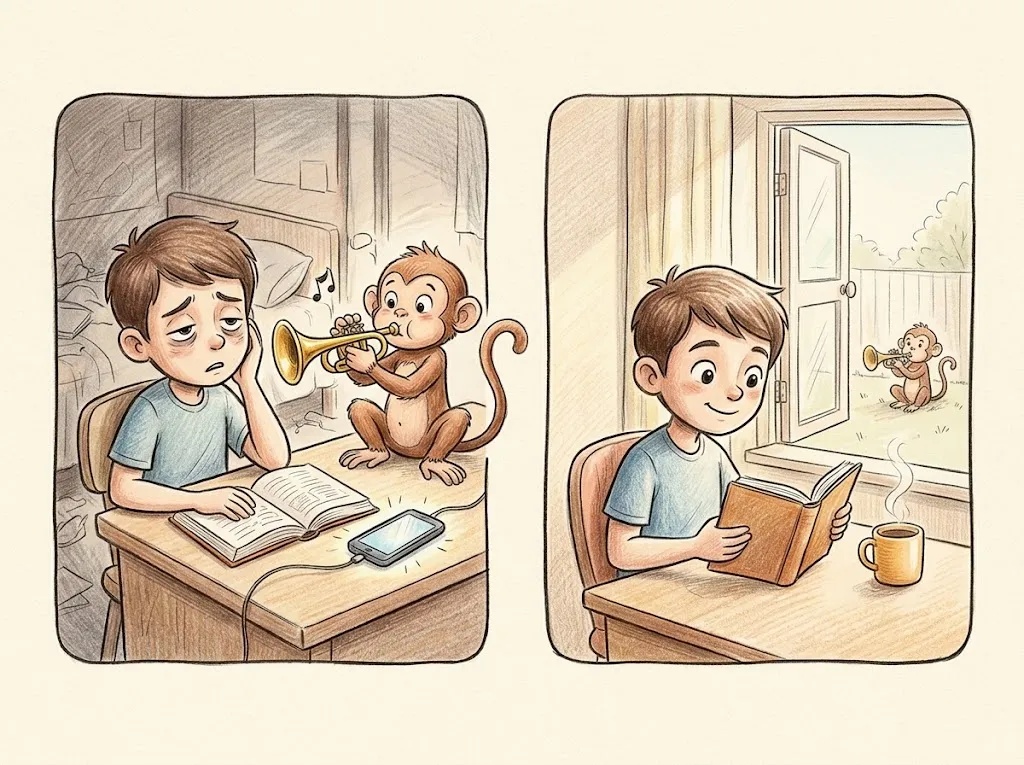
Does this scientific evidence mean our brains are permanently damaged? Joss Fong explains that scientists possess zero evidence showing irreversible biological harm. Our cognitive faculties are not fundamentally broken; instead, our everyday environment has become intensely distracting. A helpful metaphor compares a modern smartphone to an energetic monkey playing a loud trumpet inside your room. If someone plays a noisy musical instrument right beside your desk, you naturally struggle to read a novel or finish complex homework. The problem is not that your brain cannot concentrate, but that you carry this loud, distracting brass player everywhere you go.
Vocabulary_explanations
Evidence: Facts, information, or data that show whether a belief is true.Permanently: Lasting forever or existing indefinitely without changing.Possess: To have, own, or hold something.Irreversible: Impossible to reverse, undo, or return to a previous state.Faculties: Inherent mental or physical abilities and capabilities.Fundamentally: In a basic, essential, and foundational way.Metaphor: A comparison where something is described as if it were something else to explain an idea.Energetic: Full of energy, active, and lively.Naturally: As would be expected; according to normal circumstances.Novel: A long, printed fictional story.Questions:- Question: Scientists currently have strong proof that doomscrolling causes permanent brain damage.Options:
- True
- False
Answer: False - Question: In the metaphor mentioned in the text, what does the trumpet-playing monkey represent?Options:
- A) A wild pet
- B) A noisy roommate
- C) A distracting smartphone
Answer: C) A distracting smartphone - Question: What happens if you remove the distracting "monkey" from your work environment?Options:
- A) You can regain your ability to focus
- B) You permanently forget how to read books
- C) You lose your musical hearing
Answer: A) You can regain your ability to focus
- Part_number: 5Text:
Completely abandoning social networks is impractical for most individuals, especially because online feeds provide genuine humor, valuable tips, and social connection. Furthermore, setting arbitrary daily time limits, such as fifteen minutes, usually fails because app algorithms are specifically engineered to capture curiosity. Instead of relying on strict time limits, experts recommend establishing contextual boundaries. For example, resolve to scroll only during specific routines, such as walking on an exercise treadmill. By keeping phones out of quiet study zones and bedrooms, you move the noisy trumpet far away. When you remove intense stimulation, your natural concentration returns, enabling you to read books with peace.
Vocabulary_explanations
Impractical: Not sensible, realistic, or easy to carry out in daily life.Genuine: Real, authentic, and truly what it seems to be.Arbitrary: Based on random choice or impulse rather than a clear reason or system.Algorithms: Automated computer rules designed to select and display content.Engineered: Designed, built, or programmed carefully to achieve a specific goal.Curiosity: A strong desire to know, learn, or see something new.Contextual: Related to particular situations, places, or surrounding circumstances.Boundaries: Limits or rules that establish what is acceptable and what is not.Resolve: To make a firm, decisive choice to do something.Enabling: Making it possible or providing the necessary conditions for someone to do something.Questions:- Question:
Setting a strict fifteen-minute daily time limit is generally considered the most effective way to stop scrolling.
Options:- True
- False
Answer: False - Question: What is a "contextual boundary" for smartphone usage?Options:
- A) Limiting your scrolling to specific physical locations or routines
- B) Buying a phone with a smaller screen
- C) Changing your social media password daily
Answer: A) Limiting your scrolling to specific physical locations or routines - Question: Why are social media algorithms difficult to resist?Options:
- A) They cost a monthly fee
- B) They are engineered to trigger our curiosity
- C) They shut down after one hour
Answer: B) They are engineered to trigger our curiosity
Critical Thinking
Title: Critical Thinking & DiscussionInstructions:Why do you think the physical action of swiping makes people feel more compulsive compared to watching a traditional television show or movie?
If you were to establish your own contextual boundaries for your smartphone, what specific places or times would you designate as phone-free zones?
References
Recommended for You

Generations and Register: Finding Common Ground in Communication
Explore how employers, educators, and students navigate generational differences in formal and informal language registe...

The Joy of Hobbies: Why Having Fun Is Never a Waste of Time
Learn why hobbies should be fun, relaxing, and free from social media pressure in this easy A2 English reading lesson.

Finding the Perfect Path: Three Perspectives on Modern Work
Explore diverse career perspectives on work-life balance, self-employment, and workplace priorities in this English read...