
Earth Science: Inside a Volcano
Learn how magma rises through the Earth's crust, causes volcanic eruptions, and creates rich soil for farming in this A2 English reading worksheet.
Earth Science: Inside a Volcano
Learn how magma rises through the Earth's crust, causes volcanic eruptions, and creates rich soil for farming in this A2 English reading worksheet.
Title
Earth Science: Inside a VolcanoSeo_intro
Learn how magma rises through the Earth's crust, causes volcanic eruptions, and creates rich soil for farming in this A2 English reading worksheet.
Reading Text
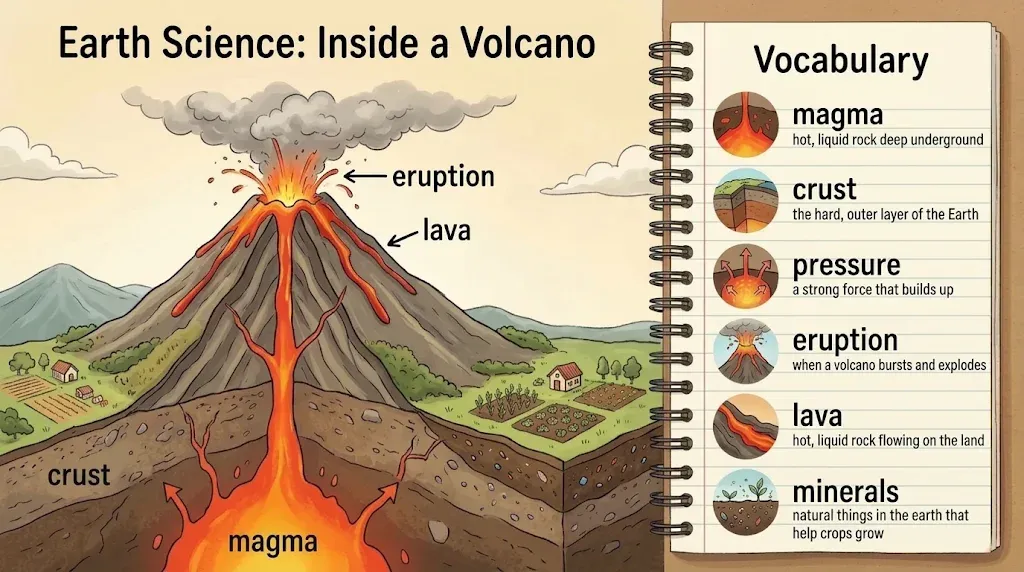
Deep underground, the Earth is so hot that solid rock melts into thick liquid rock called magma. Because magma is lighter than the solid rock around it, it slowly rises upward through cracks in the Earth's crust. When this hot magma collects in a large underground chamber, pressure begins to build up. Eventually, the pressure becomes much too strong, and the magma bursts up through an opening at the surface. Scientists call this dramatic event a volcanic eruption. Once the melted rock flows out onto the land, it is called lava. Some volcanoes erupt gently with slow, runny lava, while others explode suddenly with huge clouds of ash, dust, and gas. As the hot lava cools down, it hardens into dark black rock. Over hundreds of years, layers of cooled lava and ash stack up to build a tall mountain. Even though eruptions can damage nearby towns and farmland, volcanic ash also brings rich minerals to the soil. As a result, farmers often plant crops on the sunny slopes around sleeping volcanoes.
Activities
Vocabulary
- Label: magmaAnswer: def_1
- Label: crustAnswer: def_2
- Label: pressureAnswer: def_3
- Label: eruptionAnswer: def_4
- Label: lavaAnswer: def_5
- Label: mineralsAnswer: def_6
- Text: Hot liquid rock found deep beneath the Earth's surface.
- Text: The hard outer layer of the Earth.
- Text: A strong force pushing against something from the inside.
- Text: A sudden explosion when rock, ash, and gas burst out of a volcano.
- Text: Hot melted rock that flows out onto the land.
- Text: Natural substances in the ground that help plants grow well.
- Before: The outer layer of our planet is called the Earth'sAfter: .Answer: crust
- Before: HotAfter: collects in large chambers deep beneath the ground.Answer: magma
- Before: When too muchAfter: builds up inside the volcano, it pushes the rock upward.Answer: pressure
- Before: During theAfter: , loud noises and thick gray clouds filled the sky.Answer: eruption
- Before: After theAfter: cools down on the land, it turns into hard black rock.Answer: lava
Comprehension
- Text: Magma rises upward because it is lighter than the solid rock around it.Answer: true
- Text: Melted rock is still called magma after it flows out onto the land.Answer: false
- Text: Every volcano explodes suddenly with huge clouds of ash and gas.Answer: false
- Text: Tall volcanic mountains are built from layers of cooled lava and ash over hundreds of years.Answer: true
- Text: Volcanic ash makes the soil rich with minerals, which helps farmers grow crops.Answer: true
- Answer: Solid rock melts into thick liquid rock called magma.
- Answer: It slowly rises upward through cracks in the Earth's crust.
- Answer: Scientists call this dramatic event a volcanic eruption.
- Answer: As the hot lava cools down, it hardens into dark black rock.
- Answer: Volcanic ash also brings rich minerals to the soil.
Written Expression
- Text: Would you want to live near a sleeping volcano where the soil is good for farming? Why or why not?
- Text: Imagine you are a scientist watching a volcano erupt from a safe distance. What do you see and hear?
Example 1: I would not want to live near a sleeping volcano because it might wake up and erupt one day. Even though the soil is great for growing crops, I think safety is more important.
Example 2: From a safe distance, I see bright orange lava flowing slowly down the mountain and a huge cloud of gray ash rising into the sky. I hear loud rumbling sounds like thunder.
Critical Thinking
Why do you think people throughout history have chosen to build towns and farms near volcanoes even though they know eruptions are dangerous?
- How can modern scientists help protect towns that are located near active or sleeping volcanoes?
Recommended for You
Astronomy: The Red Planet
Learn about Mars, our closest planetary neighbor, its massive volcanoes, thin atmosphere, and the robotic rovers explori...
Physics: Sound Waves and Music
An A2-level ESL reading comprehension worksheet exploring the physics of sound waves, vibrations, pitch, and volume thro...
Physics: Friction and Moving Vehicles
Learn about how friction affects cars and trucks on dry and icy roads in this A2 English reading and vocabulary workshee...