
Astronomy: The Red Planet
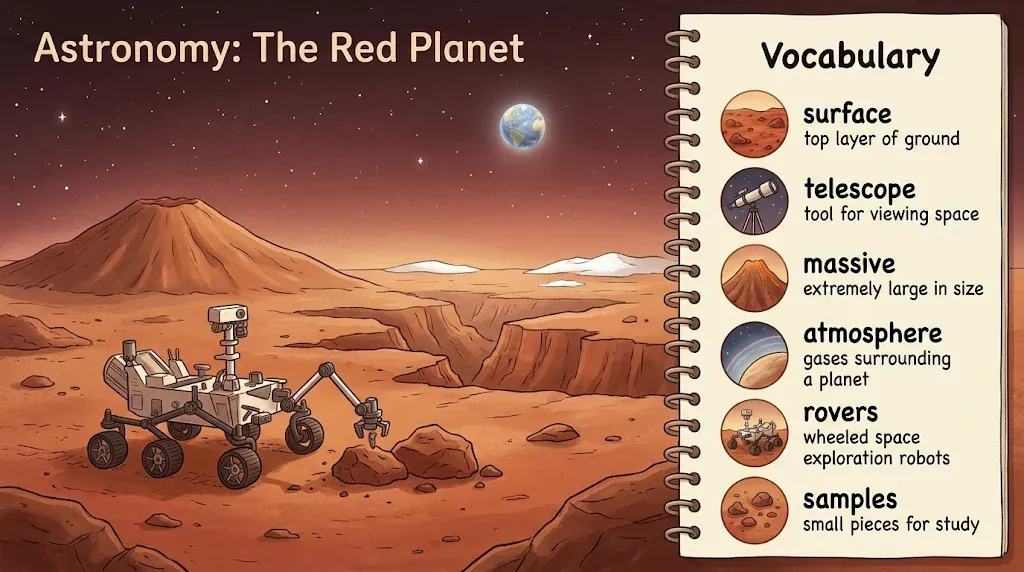
Learn about Mars, our closest planetary neighbor, its massive volcanoes, thin atmosphere, and the robotic rovers exploring its rusty red surface in this A2 English reading worksheet.
Astronomy: The Red Planet
Learn about Mars, our closest planetary neighbor, its massive volcanoes, thin atmosphere, and the robotic rovers exploring its rusty red surface in this A2 English reading worksheet.
Title
Astronomy: The Red PlanetSeo_intro
Learn about Mars, our closest planetary neighbor, its massive volcanoes, thin atmosphere, and the robotic rovers exploring its rusty red surface in this A2 English reading worksheet.
Reading Text
Mars is the fourth planet from the sun and our closest neighbor in space. People often call it the Red Planet because rusty iron dust covers its rocky surface. Through a strong telescope, Mars looks like a bright red star in the night sky. Even though Mars is much smaller than Earth, the two planets share several interesting facts. For instance, a day on Mars lasts just over twenty-four hours. Mars also has seasons, ice caps, and massive canyons. In fact, it has the largest volcano in our solar system, which stands three times taller than Mount Everest. However, human visitors cannot breathe the thin air on Mars without special helmets and space suits. The atmosphere contains mostly carbon dioxide, and the weather gets extremely cold at night. Today, robotic rovers travel across the dusty landscape to collect rock samples and send data back to Earth. Scientists hope these clever machines will help us plan the next big step in space exploration.
Activities
Vocabulary
- Label: surfaceAnswer: def_1
- Label: telescopeAnswer: def_2
- Label: massiveAnswer: def_3
- Label: atmosphereAnswer: def_4
- Label: roversAnswer: def_5
- Label: samplesAnswer: def_6
- Text: The outside or top layer of something.
- Text: A long tube with glass lenses used to look at distant objects in space.
- Text: Very large, heavy, or solid.
- Text: The layer of gases surrounding a planet.
- Text: Vehicles designed to travel across the rough ground of another planet or moon.
- Text: Small pieces or amounts of something taken to be tested and studied.
- Before: Astronomers looked through a powerfulAfter: to see the rings around Saturn.Answer: telescope
- Before: TheAfter: of the moon is covered in gray dust and deep craters.Answer: surface
- Before: NASA sent two roboticAfter: to drive across the desert-like land and take photos.Answer: rovers
- Before: Earth'sAfter: protects us from the sun and gives us oxygen to breathe.Answer: atmosphere
- Before: Scientists collected soilAfter: from the mountain to check for minerals.Answer: samples
Comprehension
- Text: Mars looks red because of rusty iron dust on its ground.Answer: true
- Text: Mars is much larger than Earth.Answer: false
- Text: A day on Mars is almost the same length as a day on Earth.Answer: true
- Text: Humans can easily breathe the air on Mars without helmets.Answer: false
- Text: Robotic machines are currently collecting rocks on Mars to send information to scientists.Answer: true
- Answer: Mars is the fourth planet from the sun.
- Answer: A day on Mars lasts just over twenty-four hours.
- Answer: It has the largest volcano in our solar system.
- Answer: The weather gets extremely cold at night.
- Answer: Robotic rovers travel across the dusty landscape.
Written Expression
- Text: Would you like to visit Mars one day? Why or why not?
- Text: What three things would you pack in your bag for a long trip into space?
Example 1: I would not like to visit Mars because it is too cold at night and humans cannot breathe the air there. I prefer living on Earth where there are trees and oceans.
Example 2: For a trip into space, I would pack a camera to take pictures of the stars, a notebook to write about my journey, and my favorite snacks.
Critical Thinking
- Why do you think scientists send robotic rovers to Mars before sending human astronauts?
If humans build a city on Mars in the future, what will be the biggest problem they need to solve first (for example: air, water, food, or cold weather)?
Recommended for You
Earth Science: Inside a Volcano
Learn how magma rises through the Earth's crust, causes volcanic eruptions, and creates rich soil for farming in this A2...
Physics: Sound Waves and Music
An A2-level ESL reading comprehension worksheet exploring the physics of sound waves, vibrations, pitch, and volume thro...
Physics: Friction and Moving Vehicles
Learn about how friction affects cars and trucks on dry and icy roads in this A2 English reading and vocabulary workshee...