
Physics: Friction and Moving Vehicles
Learn about how friction affects cars and trucks on dry and icy roads in this A2 English reading and vocabulary worksheet.
Physics: Friction and Moving Vehicles
Learn about how friction affects cars and trucks on dry and icy roads in this A2 English reading and vocabulary worksheet.
Title
Physics: Friction and Moving VehiclesSeo_intro
Learn about how friction affects cars and trucks on dry and icy roads in this A2 English reading and vocabulary worksheet.
Reading Text
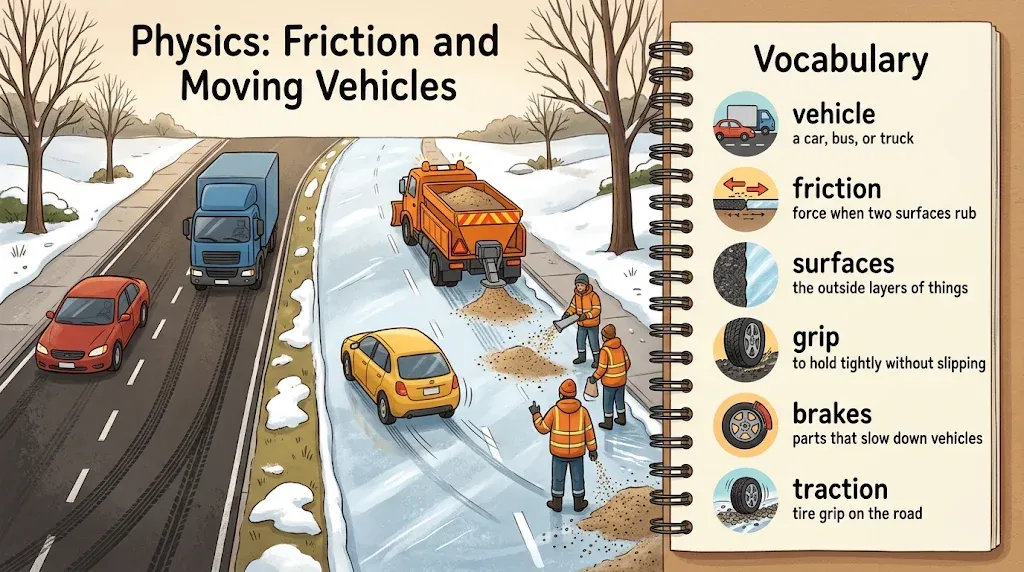
Whenever a vehicle moves along a road, two forces are at work. First, the engine pushes the vehicle forward. At the same time, friction pulls against the tires to slow them down. Friction is a force that happens when two surfaces rub together. Rough surfaces create high friction. For example, rubber tires grip dry asphalt very well. Because of this strong grip, a driver can turn corners and stop safely in just a few seconds. Heavy vehicles, like delivery trucks, need strong brakes because their extra weight makes them harder to stop. Smooth or wet surfaces have much less friction. When rain, oil, or ice covers a road, tires slide instead of gripping the ground. If a driver goes too fast on an icy road, the vehicle can slip out of control. To prevent accidents in winter, workers often spread sand or gravel over icy streets. These rough pieces give tires better traction so everyone can travel safely.
Activities
Vocabulary
- Label: vehicleAnswer: def1
- Label: frictionAnswer: def2
- Label: surfacesAnswer: def3
- Label: gripAnswer: def4
- Label: brakesAnswer: def5
- Label: tractionAnswer: def6
- Text: a machine with wheels, such as a car or truck, that carries people or things
- Text: the force that slows things down when two objects rub against each other
- Text: the top or outside layers of objects
- Text: to hold tightly onto something without slipping
- Text: the parts of a car or bike that make it slow down or stop
- Text: the ability of a wheel or tire to hold the ground without sliding
- Before: A delivery truck is a very heavyAfter: that carries boxes.Answer: vehicle
- Before: You must press theAfter: when you see a red traffic light.Answer: brakes
- Before: Workers put sand on icy roads to give car tires betterAfter: .Answer: traction
- Before: Rubber tiresAfter: dry roads much better than wet roads.Answer: grip
- Before: Ice and glass are examples of very smoothAfter: .Answer: surfaces
Comprehension
- Text: The engine pulls against the tires to slow the vehicle down.Answer: false
- Text: Rough surfaces create more friction than smooth surfaces.Answer: true
- Text: Heavy delivery trucks are easier to stop than small cars.Answer: false
- Text: Tires slide easily when oil or rain covers the road.Answer: true
- Text: Workers spread sand or gravel on icy streets to help drivers travel safely.Answer: true
- Answer: Two forces are at work whenever a vehicle moves.
- Answer: Rubber tires grip dry asphalt very well.
- Answer: Heavy vehicles need strong brakes to stop safely.
- Answer: Smooth or wet surfaces have much less friction.
- Answer: Workers spread sand or gravel over icy streets.
Written Expression
- Text: What happens to a car when a driver goes too fast on an icy road? Write 2-3 sentences.
- Text:
Compare driving on a dry road and driving on a wet road. Which one is safer and why? Write 2-3 sentences.
Example 1: When a driver goes too fast on an icy road, the tires cannot grip the ground. The car can slide and slip out of control, which causes accidents.
Example 2: Driving on a dry road is much safer than driving on a wet road. Dry asphalt is rough and creates high friction, so a driver can stop in a few seconds.
Critical Thinking
Think about the shoes you wear in winter or for sports. How do the bottoms of those shoes use friction to keep you from falling?
Besides cars and roads, where else in your daily life is friction helpful? Where is friction a problem?
Recommended for You
Physics: Sound Waves and Music
An A2-level ESL reading comprehension worksheet exploring the physics of sound waves, vibrations, pitch, and volume thro...

The Secret to Happiness: Living Gratefully
A B1-level reading comprehension worksheet exploring Brother David Steindl-Rast's teachings on how gratefulness cultivat...
The Psychology of Shopping: Why We Spend More
Explore how supermarkets and online stores use psychological nudges, anchoring, and loss aversion to influence consumer ...