How Pigs and Ducks Stay Healthy on the Farm
Explore how pigs and ducks use unique body adaptations like mud, feathers, and webbed feet to survive and thrive in their farm habitats. Includes A2-level science reading and interactive ESL activities.
How Pigs and Ducks Stay Healthy on the Farm
Explore how pigs and ducks use unique body adaptations like mud, feathers, and webbed feet to survive and thrive in their farm habitats. Includes A2-level science reading and interactive ESL activities.
Title
How Pigs and Ducks Stay Healthy on the FarmSeo_intro
Explore how pigs and ducks use unique body adaptations like mud, feathers, and webbed feet to survive and thrive in their farm habitats. Includes A2-level science reading and interactive ESL activities.
Reading Text
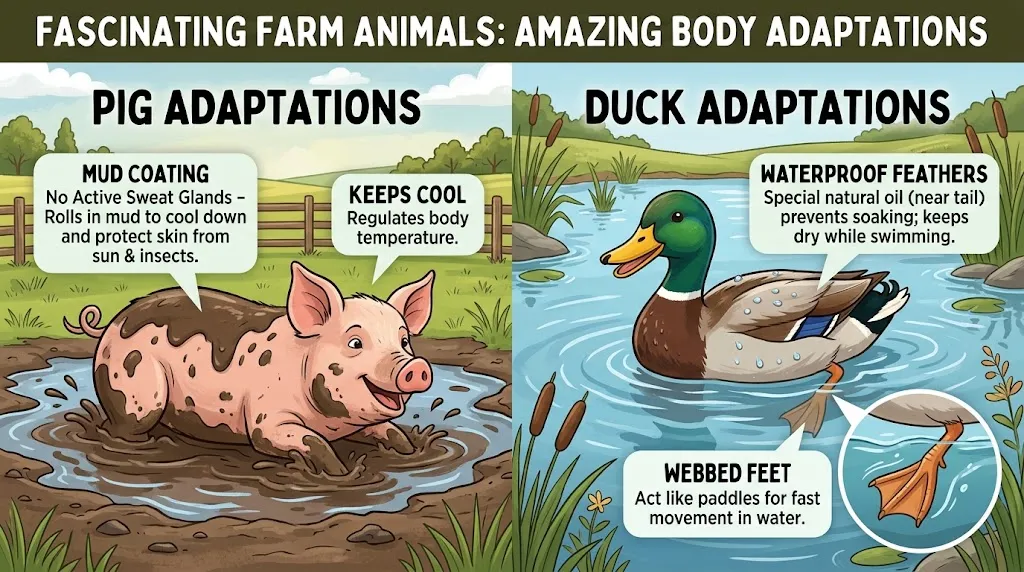
Pigs and ducks are fascinating farm animals with special body adaptations to survive in their habitats. Pigs do not have active sweat glands, so they cannot sweat when the weather is hot. Instead, they roll in cool mud to protect their skin from the strong sun and biting insects. The wet layer also keeps their body temperature balanced. Ducks have different features to live near water. They have waterproof feathers covered in a special natural oil produced near their tail. This oil prevents water from reaching their skin, allowing them to stay completely dry while swimming. Ducks also have webbed feet that act like small paddles to move quickly across ponds.
Activities
Vocabulary
- Label: adaptationsAnswer: def_1
- Label: habitatsAnswer: def_2
- Label: sweatAnswer: def_3
- Label: protectAnswer: def_4
- Label: waterproofAnswer: def_5
- Label: webbedAnswer: def_6
- Text: Special features or behaviors that help living things survive
- Text: The natural homes or environments of animals
- Text: To produce liquid through the skin to cool down
- Text: To keep someone or something safe from harm or danger
- Text: Not allowing water to pass through or soak in
- Text: Having skin connecting the toes to help with swimming
- Before: Animals develop specialAfter: to live in cold or hot places.Answer: adaptations
- Before: Forests and wetlands are importantAfter: for many wild birds.Answer: habitats
- Before: When people run on a sunny day, they begin toAfter: heavily.Answer: sweat
- Before: Sunglasses help toAfter: your eyes from the bright sunlight.Answer: protect
- Before: You should wear aAfter: jacket when it rains outside.Answer: waterproof
Comprehension
- Text: Pigs roll in mud because they cannot sweat easily.Answer: true
- Text: Mud protects pig skin from the sun and insect bites.Answer: true
- Text: Ducks get completely soaked and wet when they swim.Answer: false
- Text: Natural oil on duck feathers keeps water away from their skin.Answer: true
- Text: Ducks use their webbed feet to climb tall farm trees.Answer: false
- Answer: Pigs and ducks have special body adaptations.
- Answer: Pigs roll in cool mud on hot days.
- Answer: Special oil keeps duck feathers completely dry.
- Answer: Webbed feet help ducks swim across the pond.
- Answer: These physical features help animals survive in nature.
Written Expression
- Text: How do humans keep cool in hot weather compared to pigs?
- Text: Describe another animal and one special body feature it uses to survive.
Example 1: Unlike pigs, humans can sweat to cool down, and we can also drink cold water or turn on an electric fan.
Example 2: Polar bears have thick white fur and a layer of fat under their skin to stay warm in freezing Arctic snow.
Critical Thinking
- What might happen to a duck if its feathers could not produce natural waterproof oil?
- Why do different farm animals need different adaptations to live in the same farm environment?
Recommended for You

Are Organic Foods Really Healthier?
Explore the debate over organic food, comparing nutritional benefits, farming standards, and costs for intermediate Engl...
A Helping Hand at the Pond
Read a story about Pig and Duck working together to rescue a stuck toy truck by the pond. Includes vocabulary, reading c...
The Cat on the Wall
A simple A2-level English reading comprehension worksheet about a boy named Dan and his brown cat Ben in the garden.