Simple Present & Adverbs of Frequency
Use adverbs of frequency (always, usually, often, sometimes, rarely, never) to show how often an action happens.
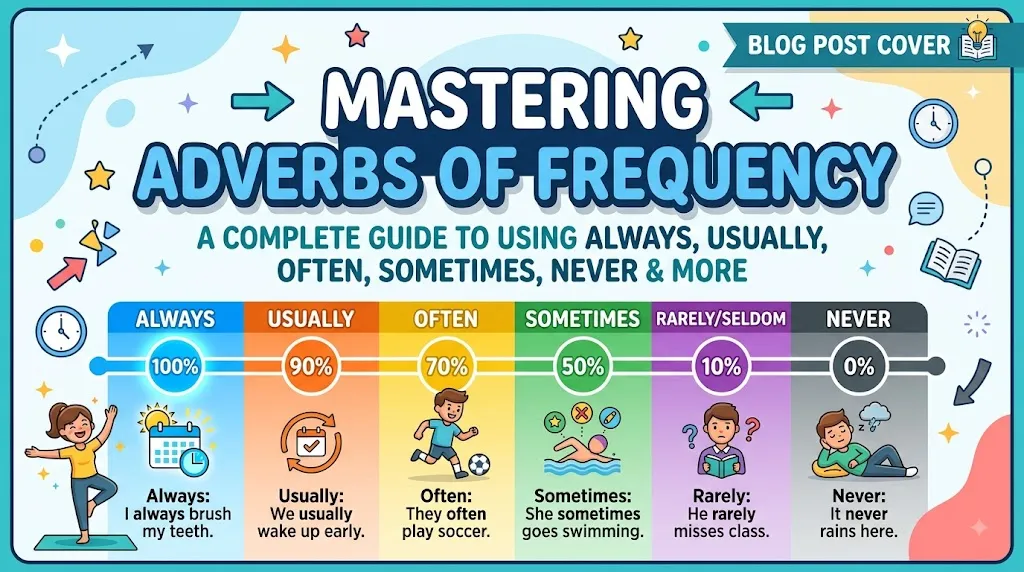
Simple Present & Adverbs of Frequency
Use adverbs of frequency (always, usually, often, sometimes, rarely, never) to show how often an action happens.
- Title: Simple Present & Adverbs of Frequency
Hint
Summary: Adverbs of Frequency RulesContent:Use **adverbs of frequency** (always, usually, often, sometimes, rarely, never) to show how often an action happens. * Place adverbs **before** main verbs: *She **always eats** breakfast.* * Place adverbs **after** the verb *to be*: *He **is usually** late.* * Use **Simple Present** for routines and general truths.
Questions:- Question: She ___ (always / eat) breakfast at 7 AM.Options:
- always eats
- eats always
- is eating always
Explanation: Put the adverb **before** the main verb: *always eats*. - Question: They ___ late for class on Mondays.Options:
- are never
- never are
- does never
Explanation: Adverbs of frequency go **after** the verb *to be*: *are never*. - Question: My father ___ coffee in the evening.Options:
- rarely drinks
- drinks rarely
- is rarely drinking
Explanation: Place *rarely* **before** the main verb *drinks*. - Question: He ___ busy on weekends.Options:
- is usually
- usually is
- does usually
Explanation: The adverb *usually* comes **after** the verb *is*. - Question: How often ___ to the gym?Options:
- do you go
- go you
- you do go
Explanation: Use *do + subject + verb* to form questions in simple present. - Question: We ___ watch TV after dinner.Options:
- sometimes
- are sometimes
- does sometimes
Explanation: *Sometimes* can sit directly before the main verb *watch*. - Question: Sarah ___ up early on Sundays.Options:
- doesn't usually get
- usually doesn't gets
- not usually gets
Explanation: In negative sentences, place the adverb between *doesn't* and the base verb. - Question: I ___ happy when it rains.Options:
- am seldom
- seldom am
- do seldom be
Explanation: Place *seldom* **after** the verb *to be* (*am*). - Question: ___ she often visit her grandparents?Options:
- Does
- Is
- Do
Explanation: Use *Does* for singular third-person subjects (*she*) in simple present questions. - Question: Mark and John ___ play video games together.Options:
- often
- are often
- does often
Explanation: Place *often* before the main action verb *play*. - Instruction: Fill in the blank:Question: I ___ (always / wake up) at 6:00 AM.Answer:
- always wake up
Explanation: Put *always* before the main verb *wake up*. - Instruction: Fill in the blank:Question: She ___ (never / lie) to her friends.Answer:
- never lies
Explanation: Use singular *s* ending for third-person subjects (*she never lies*). - Instruction: Fill in the blank:Question: He ___ (usually / be) tired after work.Answer:
- is usually
Explanation: Place *usually* after the verb *to be* (*is*). - Instruction: Fill in the blank:Question: They ___ (often / go) to the beach in summer.Answer:
- often go
Explanation: Place *often* before the base verb *go*. - Instruction: Fill in the blank:Question: We ___ (sometimes / play) tennis on Saturdays.Answer:
- sometimes play
Explanation: Place *sometimes* before the main verb *play*. - Instruction: Fill in the blank:Question: My sister ___ (rarely / eat) fast food.Answer:
- rarely eats
Explanation: Add *-s* to the main verb for third-person singular subjects (*eats*). - Instruction: Fill in the blank:Question: The buses ___ (always / be) on time here.Answer:
- are always
Explanation: Use *are* for plural subjects and place *always* after it. - Instruction: Fill in the blank:Question: ___ (do / usually / you / study) in the library?Answer:
- Do you usually study
Explanation: Order for questions: Auxiliary (*Do*) + Subject (*you*) + Adverb (*usually*) + Verb (*study*). - Instruction: Fill in the blank:Question: Tom ___ (not / usually / walk) to school.Answer:
- doesn't usually walk
- does not usually walk
Explanation: Negative form: *doesn't* + adverb + base verb. - Instruction: Fill in the blank:Question: You ___ (always / be) kind to everyone.Answer:
- are always
Explanation: Place the adverb *always* after *are*. - Sentence: She always drinks water in the morning.Explanation: Subject + adverb (*always*) + verb (*drinks*) + object + time expression.
- Sentence: He is usually happy at school.Explanation: Subject + verb *to be* (*is*) + adverb (*usually*) + adjective + location.
- Sentence: They never eat meat on Fridays.Explanation: Subject + adverb (*never*) + verb (*eat*) + object + time phrase.
- Sentence: We often go to the park.Explanation: Subject + adverb (*often*) + main verb (*go*) + prepositional phrase.
- Sentence: My brother plays football every weekend.Explanation: Subject + verb (*plays*) + object + time expression (*every weekend*).
- Sentence: Do you usually clean your room?Explanation: Auxiliary (*Do*) + subject (*you*) + adverb (*usually*) + verb (*clean*) + object?
- Sentence: She does not often watch movies.Explanation: Subject + *does not* + adverb (*often*) + main verb (*watch*) + object.
- Sentence: I am sometimes late for work.Explanation: Subject + verb *to be* (*am*) + adverb (*sometimes*) + adjective + prepositional phrase.
- Sentence: Cats rarely swim in deep water.Explanation: Subject + adverb (*rarely*) + main verb (*swim*) + location phrase.
- Sentence: How often do you read books?Explanation: Question phrase (*How often*) + auxiliary (*do*) + subject (*you*) + verb (*read*) + object?
Recommended for You

Question Tags - Level 2
Practice making natural conversation in English by adding mini-questions to the end of your sentences.

Avoiding Repetition with Auxiliaries

Linkers - Speed Run
Linkers (linking words or conjunctions) help show the relationship between two sentences or clauses—whether you want to ...