So do I & Neither can I
Practice agreeing with positive and negative statements using "So" and "Neither" with inverted auxiliary verbs across thirty interactive multiple-choice, completion, and sentence-ordering challenges.
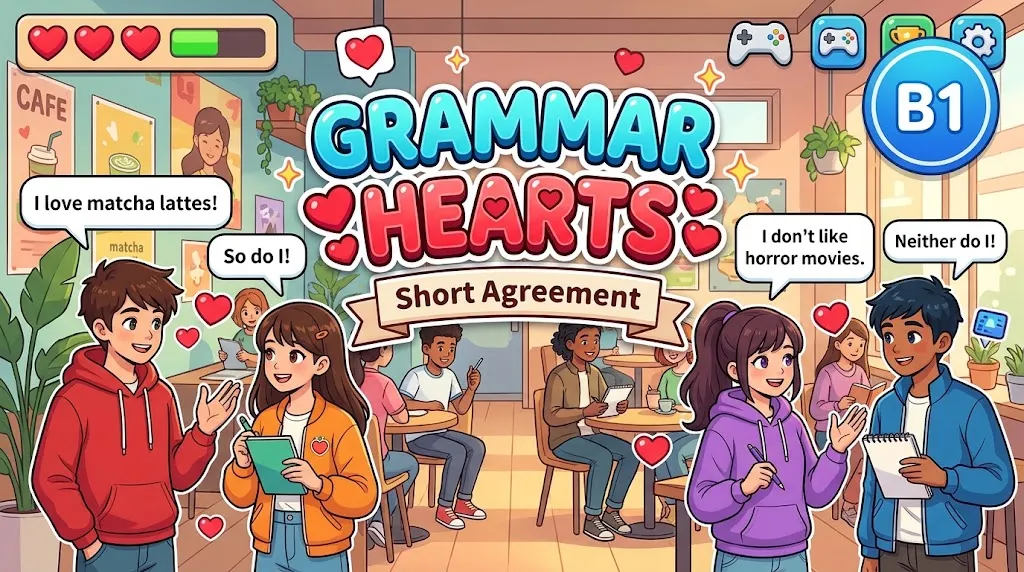
So do I & Neither can I
Practice agreeing with positive and negative statements using "So" and "Neither" with inverted auxiliary verbs across thirty interactive multiple-choice, completion, and sentence-ordering challenges.
- Title: Mastering Short Agreement: So do I & Neither can I
Hint
Summary: Short Agreement (So / Neither + Auxiliary + Subject)Content:To agree with someone quickly, invert the auxiliary verb and the subject: * **Positive Statements (+)**: Use **So + Auxiliary + Subject**. * *"I love matcha lattes."* → *"**So do I!**"* * *"She is excited."* → *"**So am I.**"* * **Negative Statements (-)**: Use **Neither + Auxiliary + Subject**. * *"I don't like horror movies."* → *"**Neither do I!**"* * *"I can't swim."* → *"**Neither can I.**"* * **Avoid the "Me Too" Trap**: Never use *"Me too"* for negative statements. Use *"Neither do/can/have I!"* * **Auxiliary Harmony**: Always match the tense and verb form: * **Be verbs**: *am / is / are / was / were* * **Do verbs** (Simple tenses): *do / does / did* * **Perfect aspect**: *have / has / had* * **Modals**: *can / could / will / would / should*
Questions:- Question: "I love matcha lattes!" — "___"Options:
- So do I.
- Neither do I.
- So am I.
Explanation: Use **So** with the present simple auxiliary **do** to agree with a positive lexical verb. - Question: "I don't like horror movies." — "___"Options:
- Neither do I.
- So do I.
- Me too.
Explanation: Use **Neither** with **do** to agree with a negative present simple sentence. Never say *Me too*. - Question: "I am super excited about the school trip!" — "___"Options:
- So am I.
- So do I.
- So have I.
Explanation: Echo the copula verb **be** (*am*) for the subject *I*. - Question: "I didn't finish the history readings." — "___"Options:
- Neither did I.
- Neither do I.
- So did I.
Explanation: Use **Neither** and match the past simple tense using the auxiliary **did**. - Question: "I haven't eaten lunch yet." — "___"Options:
- Neither have I.
- Neither did I.
- So haven't I.
Explanation: Match the present perfect tense with **Neither have I**. - Question: "I can't study in noisy spaces." — "___"Options:
- Neither can I.
- So can I.
- Neither do I.
Explanation: Retain the modal verb **can** after **Neither** to agree with a negative modal statement. - Question: Elena loves vintage shopping, and ___.Options:
- so do her friends
- so her friends do
- neither do her friends
Explanation: Use inverted order (**auxiliary + plural subject**) with **so** for a positive sentence. - Question: "I won't miss dance practice tomorrow." — "___"Options:
- Neither will I.
- So will I.
- Me too.
Explanation: Match the future modal *will* with **Neither will I** to agree with a negative statement. - Question: We were exhausted after the long trip, and ___.Options:
- so was Jack
- so did Jack
- neither was Jack
Explanation: Match the past tense of *be* for the singular subject *Jack* using **so was Jack**. - Question: Liam isn't going to the party tonight, and ___.Options:
- neither am I
- so am I
- neither do I
Explanation: Use **neither** followed by the verb *be* (*am*) to agree negatively for the subject *I*. - Instruction: Fill in the blank with the correct auxiliary or modal verb:Question: "I really enjoy spicy food." — "So ___ I."Answer:
- do
Explanation: Use present simple **do-support** (*do*) for the subject *I*. - Instruction: Fill in the blank with the correct auxiliary or modal verb:Question: "I don't drink coffee after dinner." — "Neither ___ I."Answer:
- do
Explanation: Use the positive auxiliary **do** after *Neither* to express negative agreement. - Instruction: Fill in the blank with the correct auxiliary or modal verb:Question: "I'm obsessed with Olivia's new single!" — "So ___ I."Answer:
- am
Explanation: Match the copula verb *be* (*am*) for the first-person subject *I*. - Instruction: Fill in the blank with the correct auxiliary or modal verb:Question: "I didn't watch the football match last night." — "Neither ___ I."Answer:
- did
Explanation: Match the past simple negative using the auxiliary **did** after *Neither*. - Instruction: Fill in the blank with the correct auxiliary or modal verb:Question: "I haven't visited London before." — "Neither ___ I."Answer:
- have
Explanation: Use the present perfect auxiliary **have** to match the prompt's tense. - Instruction: Fill in the blank with the correct auxiliary or modal verb:Question: "I can speak three languages fluently." — "So ___ I."Answer:
- can
Explanation: Repeat the modal auxiliary **can** to express shared ability. - Instruction: Fill in the blank with the correct auxiliary or modal verb:Question: "I won't be late for class tomorrow." — "Neither ___ I."Answer:
- will
Explanation: Use the uncontracted modal **will** following *Neither*. - Instruction: Fill in the blank with the correct auxiliary or modal verb:Question: We were very nervous about the exam, and so ___ David.Answer:
- was
Explanation: Use the singular past copula **was** to match the subject *David*. - Instruction: Fill in the blank with the correct auxiliary or modal verb:Question: Tom doesn't eat meat, and neither ___ his parents.Answer:
- do
Explanation: Use plural present simple **do** to agree with the subject *his parents*. - Instruction: Fill in the blank with the correct auxiliary or modal verb:Question: Sarah has lived here for five years, and so ___ we.Answer:
- have
Explanation: Match the present perfect aspect with **have** for the plural subject *we*. - Sentence: Mark loves Italian food, and so do I.Explanation: Follow the inverted pattern: connector + **so + auxiliary + subject**.
- Sentence: I don't like horror movies, and neither does Sam.Explanation: Use **neither + does + singular subject** for negative agreement.
- Sentence: She is excited about the concert, and so am I.Explanation: Invert the verb *be* before the pronoun: **so am I**.
- Sentence: We didn't finish the homework, and neither did they.Explanation: Use **neither + did + subject** for past negative agreement.
- Sentence: I haven't seen that film yet, and neither have you.Explanation: Use **neither + have + subject** for present perfect agreement.
- Sentence: He can't study in noisy rooms, and neither can I.Explanation: Match the modal verb: **neither can I**.
- Sentence: Elena loves vintage shopping, and so do her friends.Explanation: Use plural do-support: **so do her friends**.
- Sentence: We aren't ready for the test, and neither is Jack.Explanation: Use singular copula inversion: **neither is Jack**.
- Sentence: Anna won't attend the meeting tomorrow, and neither will I.Explanation: Use future modal inversion: **neither will I**.
- Sentence: They were late for the train, and so were we.Explanation: Use past plural copula inversion: **so were we**.
Recommended for You
Avoiding Repetition - Standalone Auxiliaries
Master natural English by replacing repetitive verb phrases with standalone auxiliaries. Practice choosing, typing, and ...
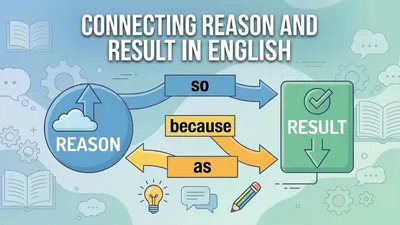
Cause and Effect: Because, As, and So
Master connecting causes and results in English using because, as, and so! Complete thirty exciting grammar challenges, ...

Question Tags - Level 2
Practice making natural conversation in English by adding mini-questions to the end of your sentences.