Smart Study Secrets: Easy Ways to Ace Your Tests
Discover easy, science-backed study tips for middle schoolers to improve memory, prepare for exams, and study with confidence.
Smart Study Secrets: Easy Ways to Ace Your Tests
Discover easy, science-backed study tips for middle schoolers to improve memory, prepare for exams, and study with confidence.
Title
Smart Study Secrets: Easy Ways to Ace Your TestsSeo_intro
Discover easy, science-backed study tips for middle schoolers to improve memory, prepare for exams, and study with confidence.
Parts
- Part_number: 1Text:
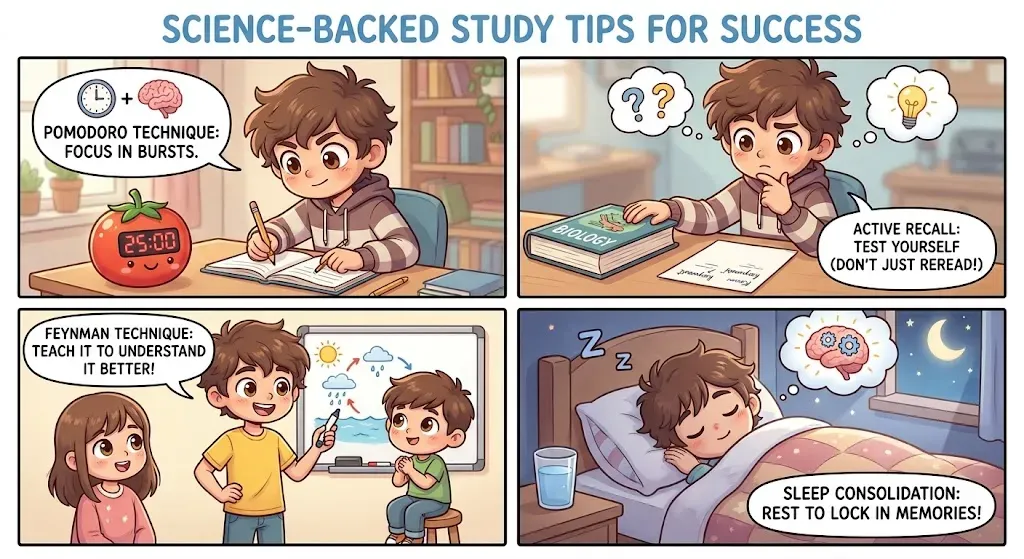
Many students sit and read for hours without stopping. They think this is the fastest way to prepare for an exam. However, scientific studies show that your brain gets tired very quickly when you do not rest. A great method is to study in short steps using a timer. Try to focus on one lesson for twenty-five minutes, and then take a five-minute break. Stand up, stretch your body, or drink water. These small pauses help your mind feel fresh, stay alert, and remember facts much better.
Vocabulary_explanations
Fastest: Taking the least amount of time.Prepare: To make ready for something in the future.Scientific: Related to science and careful testing.Studies: Research projects done to find new facts.Method: A planned way of doing something.Timer: A tool or clock that rings when time is up.Stretch: To make your arms and legs reach out straight.Pauses: Short times when you stop doing an action.Alert: Awake, quick, and ready to notice things.Remember: To keep facts in your mind and not forget.Questions:- Question: Studying for long hours without a break keeps your mind fresh.Options:
- True
- False
Answer: False - Question: What is a good amount of time to focus before taking a five-minute break?Options:
- A) 10 minutes
- B) 25 minutes
- C) 60 minutes
Answer: B) 25 minutes - Question: What is a good activity during a short study break?Options:
- A) Stretch and drink water
- B) Take a long two-hour nap
- C) Read another whole chapter
Answer: A) Stretch and drink water
- Part_number: 2Text:
Reading your notebook again and again feels easy, but it does not test your brain. When you look at sentences, you think you know them, but you might forget them during a test. A better way is called active recall. This means you test yourself from memory. Close your book and try to write down the answers on empty paper. You can also make flashcards with words and simple meanings. When your brain works hard to find the right answer without looking, the memory becomes much stronger for test day.
Vocabulary_explanations
Feels: Gives a particular sensation or thought.Active recall: Testing your memory by answering questions without looking at notes.Means: Explains the definition or purpose of something.Test: To check what you know or can do.Empty: Having nothing inside or written on it.Flashcards: Small cards used for learning words and facts.Meanings: What words, signs, or ideas represent.Hard: Needing a lot of effort and energy.Stronger: More powerful and less likely to be forgotten.Test day: The specific day when an exam happens.Questions:- Question: Reading your notebook many times is the best way to test your memory.Options:
- True
- False
Answer: False - Question: What is an example of active recall?Options:
- A) Closing the book and writing answers from memory
- B) Listening to loud music
- C) Looking at pictures only
Answer: A) Closing the book and writing answers from memory - Question: Why are flashcards helpful for students?Options:
- A) They help you color neatly
- B) They make your brain practice finding facts
- C) They replace all school books
Answer: B) They make your brain practice finding facts
- Part_number: 3Text:
Studying all night before an exam is called cramming. Cramming makes you feel nervous, and your brain quickly forgets the facts. Instead, use spaced repetition. This strategy means reviewing your lessons over several days. For example, learn ten vocabulary words on Monday, review them on Wednesday, and check them again on Saturday. When you leave time between study sessions, your brain works to find the ideas again. This simple habit moves information into your long-term memory, so you stay calm, feel confident, and get better grades.
Vocabulary_explanations
Cramming: Trying to learn lots of facts in a very short time right before a test.Nervous: Feeling worried, afraid, or uncomfortable.Spaced repetition: Reviewing facts with breaks over days to remember them longer.Strategy: A helpful plan to reach a goal.Reviewing: Looking at or practicing something again.Several: More than two, but not a very large number.Sessions: Periods of time spent doing a single activity.Long-term memory: The part of the brain that keeps information for a long time.Confident: Feeling sure of your skills and knowledge.Grades: Scores or marks given to school work.Questions:- Question: Cramming the night before an exam helps facts stay in your memory for months.Options:
- True
- False
Answer: False - Question: What is spaced repetition?Options:
- A) Reviewing study notes across several days
- B) Reading a page ten times in one minute
- C) Skipping all homework
Answer: A) Reviewing study notes across several days - Question: Where does spaced repetition help store information in the brain?Options:
- A) In long-term memory
- B) In temporary notes
- C) Only in morning memory
Answer: A) In long-term memory
- Part_number: 4Text:
A famous scientist named Richard Feynman shared a great learning tip. He said that if you want to understand something, teach it simply. Pretend you are explaining the lesson to a younger child. Use easy words and draw simple pictures. If you get stuck or cannot explain a rule, open your book and review that part again. When you explain an idea in your own words, you quickly see what you know and what you need to practice more. This clever method makes hard topics easy to understand.
Vocabulary_explanations
Famous: Known by many people in many places.Scientist: A person who studies nature and the world.Shared: Told or gave something to other people.Understand: To know the meaning or cause of something clearly.Pretend: To imagine or act like something is true for play or practice.Explaining: Making an idea clear and easy to understand.Stuck: Unable to move forward or find the answer.Rule: A statement that tells how things work or what is allowed.Clever: Smart, quick to learn, and showing good skill.Topics: Subjects that you write, read, or talk about.Questions:- Question: Teaching a lesson with simple words helps you understand it better.Options:
- True
- False
Answer: True - Question: What should you do if you get stuck while explaining a topic?Options:
- A) Open your book and review that specific part
- B) Stop studying completely
- C) Skip the exam
Answer: A) Open your book and review that specific part - Question: Who created this famous teaching method?Options:
- A) An ancient king
- B) Richard Feynman
- C) A modern computer
Answer: B) Richard Feynman
Critical Thinking
Title: Think and DiscussInstructions:Choose one difficult topic from your science or history class. How would you explain it to an 8-year-old child using simple words?
Between testing yourself with flashcards (active recall) and spreading your study across the week (spaced repetition), which idea will you try first for your next test? Why?
Recommended for You
Study Smarter, Not Harder: Science-Backed Exam Strategies
Discover science-backed study tips for middle schoolers to prepare for exams, improve memory, beat stress, and achieve t...

Interviews on AI: Thai Graduates at a Career Crossroads
Explore three personal interview perspectives on how AI will shape job opportunities for university graduates in Thailan...

The Origin of 'Carbon Footprint'
Explore how the concept of the carbon footprint was created and why focusing on individual guilt affects working communi...