History: Finding the Rosetta Stone
Learn about the discovery of the Rosetta Stone in Egypt and how it helped unlock ancient hieroglyphs in this A2 English reading lesson.
History: Finding the Rosetta Stone
Learn about the discovery of the Rosetta Stone in Egypt and how it helped unlock ancient hieroglyphs in this A2 English reading lesson.
Title
History: Finding the Rosetta StoneSeo_intro
Learn about the discovery of the Rosetta Stone in Egypt and how it helped unlock ancient hieroglyphs in this A2 English reading lesson.
Reading Text
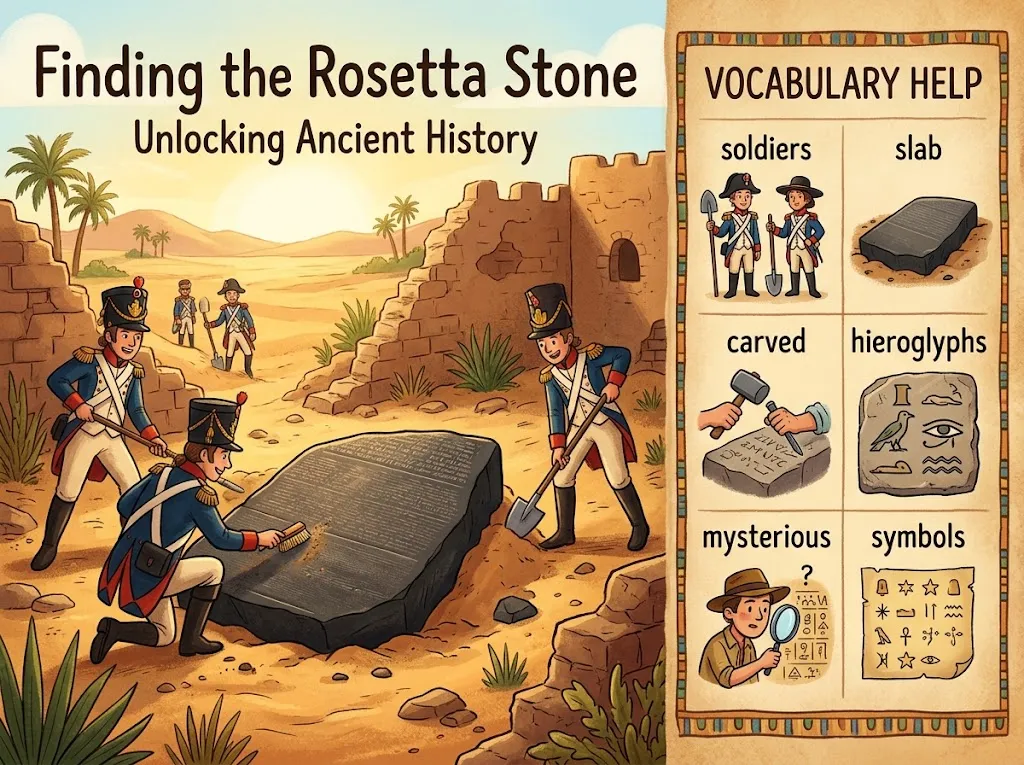
In 1799, French soldiers stayed in Egypt near a town called Rosetta. They needed to fix an old fort. The men worked under the hot sun and cleaned dirt from broken walls. While digging, one soldier stopped and looked down. He noticed a very large black stone slab buried in the ground. It weighed more than 700 kilograms, so several soldiers helped him lift it out. The stone showed writing carved in three different scripts. One script was Ancient Greek. Another was Egyptian picture writing, called hieroglyphs. For many centuries, people wanted to read these mysterious pictures, but no one could understand them. Later, the stone traveled to a museum in London. A French teacher named Jean-François Champollion studied copies of the Greek text and compared the words to the Egyptian pictures. He worked for years, counted the symbols, and finally helped unlocked the lost history of ancient Egypt.
Activities
Vocabulary
- Label: soldiersAnswer: def_1
- Label: slabAnswer: def_2
- Label: carvedAnswer: def_3
- Label: hieroglyphsAnswer: def_4
- Label: mysteriousAnswer: def_5
- Label: symbolsAnswer: def_6
- Text: people who serve and fight in an army
- Text: a thick, flat, heavy piece of stone or rock
- Text: cut into a hard surface like wood or stone
- Text: pictures or signs used as a writing system in ancient Egypt
- Text: strange, secret, or difficult to explain and understand
- Text: marks, signs, or shapes that represent an idea, sound, or word
- Before: The braveAfter: built a camp to protect the town.Answer: soldiers
- Before: The builders moved a heavyAfter: of dark rock into place.Answer: slab
- Before: The ancient artistAfter: letters deep into the stone wall.Answer: carved
- Before: EgyptianAfter: use pictures of birds, eyes, and people.Answer: hieroglyphs
- Before: The explorer discovered aAfter: box with no keyhole.Answer: mysterious
Comprehension
- Text: The French soldiers found the stone while repairing an old fort.Answer: true
- Text: One soldier lifted the heavy stone out of the ground completely alone.Answer: false
- Text: The writing on the stone was carved in three different scripts.Answer: true
- Text: People could easily read Egyptian hieroglyphs before the stone was found.Answer: false
- Text: Jean-François Champollion compared the Greek text with the Egyptian pictures.Answer: true
- Answer: The soldiers worked under the hot sun.
- Answer: He noticed a large black stone in the ground.
- Answer: The stone showed writing in three different scripts.
- Answer: No one could understand the mysterious pictures.
- Answer: The teacher studied copies of the Greek text.
Written Expression
- Text:
Imagine you find a buried ancient object in your backyard. Describe what it looks like and how you feel.
- Text: Why do you think it is important for museums to preserve old artifacts and languages?
Example Response 1: If I found an old object, it would probably be a small metal coin covered in brown dirt. I would feel very surprised and excited to show it to my history teacher.
Example Response 2: Museums are important because they protect history. When we study old objects, we can learn how people lived thousands of years ago.
Critical Thinking
Why was having Ancient Greek on the Rosetta Stone the key to unlocking the meaning of Egyptian hieroglyphs?
The Rosetta Stone was found in Egypt by French soldiers and is now in a museum in London. Where do you believe ancient historical treasures should be kept, and why?
References
Recommended for You
The Desert Fennec Fox
Learn about the fennec fox and how this small desert animal survives hot days and cold nights in the sand dunes.
Science (Biology): How Bats Protect Farm Crops
An A2-level English reading worksheet exploring how nocturnal bats help farmers by eating crop-damaging insect pests.
Scrapping Plastic Plates
An A2 reading lesson exploring how eco-friendly materials like banana leaves and sugarcane fiber replace single-use plas...